essay etiketine sahip kayıtlar gösteriliyor. Tüm kayıtları göster

2011-08-14

philosophy course revisited

Where were we?
After I did a lot of work on Locke, it was time to proceed. I was about to skip Berkeley to jump into Hume immediately, Prof. Stocker made a good remark about this man by saying "the ones who are mostly interested in science may like reading Berkeley".
That was the turn point, exactly.
I took Three Dialogues between Hylas and Philonous as the textbook of the course and began to discover.

I was never prejudiced. Okay, maybe a little bit. I knew he has a quite different kind of experimentalist point of view. He has objections against Locke's qualities which I enthusiastically tried to refute all over the first dialog which we were responsible of. I did not want to believe his thoughts on the existence of external world, indeed. And I really tried to put him down. I discussed many of his arguments against his precedents with Prof. Stocker, even sometimes got crazy about this kind of perspective which I tried my best to anticipate.

I always thought he was surely wrong.

But then, when it comes to make a conclusion from what I read and thought, surprisingly the conclusion I drew was quite different from what I thought before. I attacked him in my final paper, very badly. However, as being objective I sadly accepted he was right about some point... some point which every philosopher after him called this problem as the riddle of the philosophy... some point which even Hume accepted the final knockout and built up the new philosophy [experimental philosophy] upon this fact.

See what it is.

2011-08-11

a lost certainty or not

Here is the final work which I did in Short Stories class. Our instructor organized the course in a way that we always read science-fiction stories. I always liked them, read Asimov, Clark, Le Guin and some others. I also wrote science-fiction (I have been still writing it but I gave a little break. now it's time to recover)
As a note, this story I indeed like. It has a different kind of telling. Le Guin is always like that. I suggest especially the Left Hand of Darkness. [Karanlığın Sol Eli Türkçe çevirisi, Ayrıntı Yayınları]


13.03.2011 

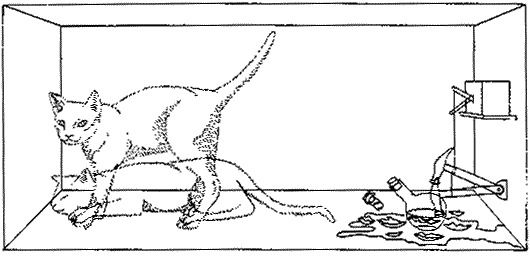
          Schrödinger’s Cat is a story which was written by Ursula K. Le Guin whose work is not easily classified and mostly mentioned with the adjective of ‘weird’. She usually discusses the social topics in her stories such as morality, political ideology, racial interactions which can differ for alternative societies or as in the story of Schrödinger’s Cat, she takes the social implications of scientific truths into consideration. The story is composed of two parts, the narration and the action part. After a heavy and poetic description of the scene, the author lets two characters speak: The narrator whose cat is Schrödinger’s Cat and the mailman dog which is dog and human simultaneously. They discuss on the experimental setup of Schrödinger and put the cat into the box. According to the Gedankenexperiment of Schrödinger, the photon can be reflected or deflected by fifty percent of probability which can trigger the instrument that releases the poison. So, by a half probability the cat is dead or alive. Since in the quantum world all probabilities can be represented as a linear combination of probability wave functions before the observation, the cat is dead and alive simultaneously again before the observation. However when a variable from the outside of the quantum world such as a human eye observes, s/he collapses all probabilities into only one probability which is also dependent on space and time. Therefore, there is no way of predicting the earlier events before the observation which can be also classified as “uncertain”. The observer brings the certainty into the space/time reality by his own will. So, in this story Le Guin dramatically puts emphasize on the effects of the apprehension of the uncertainty in the universe by giving references to scientific principles and sub/atomic world.


The references of Le Guin given to sub-atomic world are composing the descriptive part of the narration. From this perspective, it is clearly seen what the story tells is deeply related to the molecules, atoms and so on. In the very beginning, the narrator gets started as talking about the break-up of a couple. This break-up smartly symbolizes the disintegration while being a couple represents the recombination of atoms, “The pieces of him trotted around bouncing and cheeping, like little chicks, but she was finally reduced to nothing but a mass of nerves: rather like fine chicken-wire, in fact, but hopelessly tangled.” They were hopelessly tangled even they broke up, since the atoms disintegrate and recombine without ceasing. In the followings, the narrator begins to talk about the heat which is also a reference to atomic world, because it is a type of energy which speeds up the molecules. The other symbol that is common to the story is music such as the piece of The Well-Tempered Clavier by Bach and the composer Schumann at the end. Music is composed of sound waves which can be reduced to the behaviors of atoms. Moreover, the fast movements of cats are used as a symbol as well, “… all they did was ZAP and gone. They lacked presence.” They are reflected as molecules and atoms that are bouncing up and down without a stop. All these details in the story want to point out the chaos and the unpredictability of the sub/atomic world.

Le Guin evaluates the effects of grasping and understanding the uncertainty in the story. Human wants certainty due to his nature. It is hard to accept and live with uncertain events and situations. However quantum mechanics ironically shows that everything around us contains a definite amount of uncertainty. Heisenberg Uncertainty Principle already mentions that we cannot know the exact position and velocity (momentum) of a particle simultaneously.  That is why Rover, the mailman dog, says, “I can’t stand this terrible uncertainty”. Nature contains this uncertainty in its formation and shows itself in the laws. Furthermore, Le Guin points out the paralleled realities that exist simultaneously in time. Before it is decided, one event is only one of the possible future events; however after the decision, it becomes reality or certain truth. Therefore, we cannot predict previous future events and this uncertainty becomes an important problem in quantum mechanics. The quotation of “We cannot predict the behavior of the photon and thus once it has behaved, we cannot predict the state of the system it has determined… So it is beautifully demonstrated that if you desire certainty, you must create it yourself!” refers quantum weirdness of uncertainty in the story. Rover bursts into tears and his words “certainty, all I want is certainty” shows that Le Guin successfully touches the difficulty of science can be a substitute for spiritual hope.

The reader can observe plenty of scientific references in the story. In the narration part of the story, the author touches Michelangelo’s Last Judgment portrait which can be a symbol of the connection between the observation and certainty. Last Judgment comes with the observation in the experiment and “He observes. Indeed one wonders if Hell would exist, if he did not look at it”, as the narrator says. Furthermore, the quotation of “It is the note A, the one that drove the composer Schumann mad”, interestingly questions if the uncertainty of the quantum world which Heisenberg found out, drove him crazy. In one conversation, after Rover says that he wants only certainty and to know for sure that God plays dice with the world, the words of the narrator seem quite strange, “Do you think he’s going to leave you a note about it in the box?” This part of the story is like a reminder of a famous conversation between Bohr and Einstein. The words of narrator can be also interpreted as “Do you really think that you can decide whether God plays dice or not?” which is the words of Bohr directed to Einstein after his famous phrase of “God does not play dice with the world”. Ironically the information of this uncertainty is not sufficient to answer this question.

As a result, Le Guin mainly criticizes the insufficiency of science in spiritual seek of human as well as she decorates the plot with many references to atomic world and scientific principles. The uncertainty is rooted in the essence of science and it is the law of nature itself to define the event in a limited certainty. Even though it is hard to grasp this reality, we are also a part of this nature and uncertainty. That is why I wonder if we really lost the certainty, when I read last words of the story, “Wonder if he [the cat] found what it was we lost”.

My report on the Essay on Human Understanding, Book II, Parts 1-7

Locke_PP

Berkeley: essay on the existence of material world

AN ESSAY on the EXISTENCE OF the MATERIAL WORLD

getting started with philosophy

I took a course on philosophy in my second term. It was pretty exciting at the start. I thought I was gonna review everything in my mind especially about these ancients, Plato, Socrates bla bla bla. Because I was a very enthusiastic fan of rationalism in my high school years and I nearly worshipped all these old men (including Descartes, Leibniz etc). On the other hand I couldn't understand the goals of these experimentalists at those times. However, time got me wrong. After all those scientific years with projects in HS-labs, finally I got some real changes in my structure of thinking.

I was indeed curious about these experimentalist guys, such as Locke, Hume and others, [I knew Berkeley at that time but I couldn't give any meaning about nor his philosophy neither himself].

Weirdly, [not joking] quite weirdly I realized that I got bored of all these theory of ideas, philosophy on soul, mind is everything stuff. It was a complete turn for me. I even shocked myself.

I couldn't spend time with philosophers in my last year of HS because of all these exams, but surely I hadn't forgotten to play with science. [science is always a priority]
Shortly, I impatiently waited for the turn of experimentalists in the course. When the turn came to Bacon and Montaigne, I got started to be a little bit excited. Since all these great minds began telling sth about "experience".
The course had no meaning until that time for me. Yes, right now we know all these experiences show the direction of our lives baloneys; however stop and think a little bit about those times.

I am completely talking about the west right now. At those times, there was the Aristotalian authority in philosophy. Church was on everything and the thoughts of this great man [of his time but], influenced every single thing in the philosophy.
Philosophy got stuck.

Talking about the experiences and in a way experiments of our lives were a new way for philosophy. And at that age which is 19-20 when I took the course, I had understood the role of experience in my life besides the mind and rational thinking.
This experimental point of view was a really different and fascinating direction of the philosophy. At least it seemed to me in this way. Since [in a bad manner of saying] rationalists were always making up something, some theory about a concept, examining any philosopher of rationalism movement was a complete live-consuming activity. Answers varied from a mind to another mind and to be honest, what they thought was always some abstract references to another world which surely we do not inhabit.

In my early ages I really liked reading Plato, Aristo and all these men. Why? Firstly the only thing I indeed understood was the ancients and secondly, I knew all those worlds from the traditions I belonged.

I want to give a reference right here about a very lovely philosopher [as well as mathematician], Bertrand Russell. Since at this point of the writing, his words from the book named "Our Knowledge of the External World" are explanatory:

"The original impulse out of which the classical tradition developed was teh naive faith of the Greek philosophers in the omnipotence of reasoning. The discovery of geometry had intoxicated them, and its a priori deductive method appeared capable of universal application. They would prove, for instance, that all reality is one, that there is no such thing as change, that the world of sense is a world of mere illusion; and the strangeness of their results gave them no qualms because they believed in the correctness of their reasoning. Thus it came to be thought that by mere thinking the most surprising and important truths concerning the whole of reality could be established with a certainty which no contrary observations could shake. As the vital impulse of the early philosophers died away, its place was taken by authority and tradition, reinforced, in the Middle Ages and almost to our own day, by systematic theology. ..."

This part is from the first lecture called Current Tendencies. I have just started to discover this book. Anyway the point is really gripping. Why religion which we know is so close to the ancient theories of philosophy? Why do we feel a closeness when we read about Plato and others? The world of ideas does also exist in the logic of the religions. Not only this concept, but also all others keystone parts of this ancient philosophy do exist in the logic of the religions. After this movement lost its creativity, the inheritors created the authority and tradition to keep this particular way of living or in other words philosophy alive. And currently it's called systematic theology and maybe religion.

Anyway, let's turn to my course on philosophy.
I chose Locke's the Essay on Human Understanding as my presentation topic and started to read the part we are responsible of. If I can, I will publish my presentation here in this website.
It was a pretty long presentation, I had really worked for it. and I really understood this very natural philosophy. All in all, Locke is the source of the experimentalism movement.